
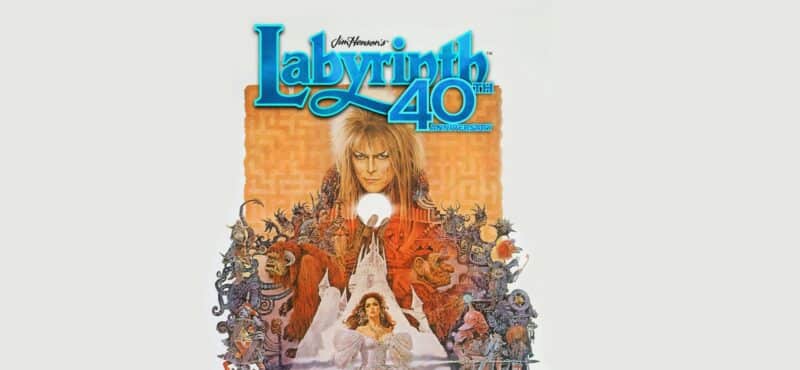
How a labyrinth of Goblins, crystal balls, and an eternal Starman teaches us to dance with life and navigate our own thresholds.
There are moments that stay imprinted in the body’s memory.
As if time itself paused to hand us a key.
For me, that key came in the form of a videocassette. I remember a rainy afternoon in Rosario, in the early ’90s. The ritual was sacred: my friend Mariana’s house, the smell of freshly popped popcorn, the warm chocolate soaking my hands, and that device that now seems like an artifact, but back then was a portal: the VCR, “the video,” as we called it.
We put the Labyrinth cassette in, and in that instant my mind soared to the cosmos. Rain hit the windows, and I felt the world disappear for a while. I left that house with messy hair, my heart beating in mysterious rhythms, mesmerized by an angelic Jennifer Connelly and the dark magnetism of David Bowie. Unknowingly, I had just received an initiation.
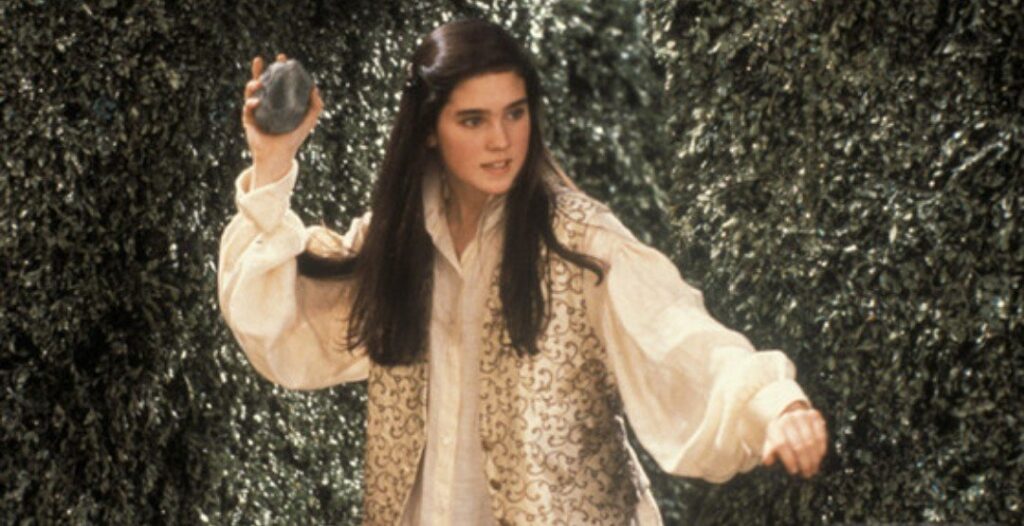
Technical Details
Title: Labyrinth
Year: 1986
Director: Jim Henson
Screenplay: Terry Jones, based on a story by Jim Henson and Dennis Lee
Music: David Bowie
Starring: Jennifer Connelly (Sarah), David Bowie (Jareth)
Genre: Fantasy, coming-of-age, initiation tale
Duration: 101 minutes
What is Labyrinth About?
Labyrinth tells the story of Sarah, a teenage girl who, in a moment of frustration and confusion, wishes her little brother away to the Goblin King. The wish comes true, and to retrieve him, Sarah must navigate a magical labyrinth filled with trials, strange creatures, riddles, and deceptive choices.
Throughout her journey, Sarah confronts illusions, temptations, and shortcuts that promise easy solutions but often lead her astray. Each encounter tests her ability to discern, trust herself, and take responsibility for her choices. The labyrinth is not merely a physical space; it is a symbolic territory where emotion, imagination, and reality intertwine.
The story culminates when Sarah realizes that the power she thought was in the Goblin King’s hands was never external—it depended on her own belief and inner maturity.
Beyond its appearance as a fantasy tale, Labyrinth can be read as an initiation story. It is not about conquest or a classic hero’s mission of mastery, but about an internal transformation guided by sensitivity, intuition, and relationship with a living world.
The labyrinth is not an enemy to defeat. It is an organic space that responds, deceives, protects, and teaches. Forests, stones, objects, and creatures seem to have their own consciousness, recalling ancient narratives where nature is both teacher and mirror of the human journey.
Sarah progresses not by imposing force, but by learning to listen, make mistakes, and correct herself.
From this perspective, Sarah’s journey echoes the archetype of the sacred feminine: a path where power does not come from external control but from emotional integration, conscious imagination, and the ability to hold one’s truth without denying it or projecting it onto another.
Reading Labyrinth this way does not negate other interpretations—romantic, psychological, or cultural—but expands them, revealing the film as a symbolic map of growth, autonomy, and reconciliation with the living world.
The labyrinth is not just a setting: it is a language. A system of symbols expressed through art, music, theater, and storytelling. Every twist, creature, and song functions like phrases in an older narrative than Sarah’s story itself. Nothing is there merely to entertain; everything communicates, seduces, or confuses, much like life does when we cross a threshold of change.
The Labyrinth of Adolescence and Feminine Initiation.
Thirty-three years after first seeing it at age eleven on a rainy afternoon in Rosario, I returned to the cinema to watch it on the big screen for its 40th anniversary and David Bowie’s birthday, now alongside my daughter Sarah, who also loves the film, the music, and probably has watched it even more times than I have. Amid Trevor Jones’ synthesizers and the owl’s hypnotic eyes, I realized that Jim Henson gave us more than a fantasy movie: he left us a manual for sovereignty, independence, and feminine power.
Sarah is a teenager standing on that uncomfortable threshold: one foot still in the toy-filled room, the other beginning to feel the vertigo of the outside world. Her struggle mirrors all of ours: the fight for identity against a world that demands immediate maturity, while the system whispers that we must remain frozen in beauty and passivity. The labyrinth is her puberty made of impossible hallways and chaotic emotions, where every decision becomes a mirror of her soul.
The sacrifice of childhood is the labyrinth’s first level. Sarah must care for her brother Toby, and in doing so, she sets aside her princess dresses. She faces a world of choices and dangers. Many of us were “Sarahs” too : young mothers learning to navigate uncertain corridors of maternal identity.
The labyrinth is confusing, unfair (“It’s not fair!” she repeats), yet it is the path to the soul’s maturity.
The characters along the way do not guide her from superior knowledge but reflect fragments of her own process. Hoggle embodies doubt and fear of losing favor; Ludo represents deep sensitivity yet to find words; Sir Didymus embodies rigid loyalty to rules that no longer always serve. They are not masters or saviors: they are moving mirrors, accompanying Sarah as she learns to make decisions for herself.
Jareth: The Rescuer Trap and False Beliefs
Midway through the journey, Jareth, the Goblin King, appears: seductive, dangerous, magnetic. He is the prince of the tale and, at the same time, the embodiment of an ancient promise: the other who offers meaning, protection, and wonder in exchange for surrender. Jareth does not represent love itself but a learned form of love—one that confuses desire with dependence and fantasy with truth. Sarah does not reject the connection; she rejects the cage. By navigating the labyrinth, she discovers that magic does not come from being chosen by a king, but from choosing herself without giving up sensitivity, imagination, or capacity to love.
Music intervenes like a spell. Jareth’s songs suspend time, alter perception, and promise meaning and beauty. They are not mere musical numbers: they function as enchantments. Whenever the music appears, Sarah risks forgetting her purpose or succumbing to a more comfortable illusion. As in ancient stories, melody can guide—or mislead.
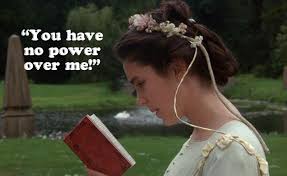
Rescue is an illusion. True freedom is sovereignty: the ability to say, “You have no power over me,” and feel it to the core; a paractice deeply rooted in setting healthy boundaries.
Sacred Aesthetics: Snakes, Stones, and Spirit Animals
Brian Froud’s design creates a living world where nothing is accidental. Sarah’s ball gown is adorned with golden arabesques and snakes, symbols of wisdom and renewal, signaling her shedding of old skin. Her allies are elemental: Ludo, who summons stones with a pure heart; guiding animals that support her path when the ego tries to confuse her; and Jareth’s crystals, living mirrors that only lose power when Sarah reconnects with her soul’s center.
Every creature, stone, and camera angle is a ritual gesture. Goblins, Fireys, and visual tricks are not mere spectacle—they are metaphors for emotional chaos, fragmentation, and the integration necessary for growth.
The Number 13: Lunar Time, Rite, and Transformation.
Sarah’s journey is marked by a number loaded with ancient memory: thirteen. She is granted thirteen hours to traverse the labyrinth and reclaim her brother. In many ancestral cultures, thirteen is not unlucky; it represents complete cycles—the thirteen moons of the lunar year, the rhythm of the body, of blood, symbolic gestation, and living time.
Before time was ordered solely by solar, productive calendars, the moon marked life’s essential rhythms. Thirteen lunar cycles form a complete cycle, a return. In this sense, Sarah’s time limit is not just a countdown; it is a temporal womb. Circular, organic time, where every step implies transformation.
Thirteen is liminal: it neither fully opens nor closes, destabilizing familiar order. Unlike the comfortable structure of twelve—months, signs, apostles—it overflows. Like the labyrinth itself, thirteen unsettles because it resists domestication.
Jareth rules time as a threat: clocks, countdowns, urgency. Time of control, fear of loss. Sarah’s journey, instead, follows another rhythm: experience, listening, error, and correction. The more aligned she is with this inner time, the less power the external threat has.
When Sarah completes the labyrinth, she does not “defeat” time: she inhabits it. The cycle closes because something within her has matured. Like the moon, she does not return to the same point: she returns transformed.
Dance Magic: The Shamanic Power of Movement
Dance is medicine. Across cultures, rites of passage—from quinceañeras to Bar Mitzvahs—require ritual movement. Mastering rhythm is mastering trance.
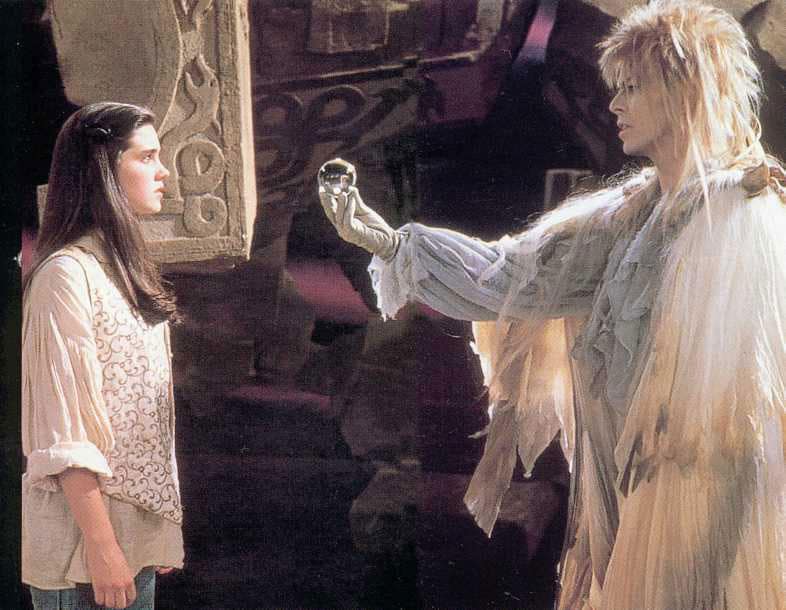
Jareth leads the “Magic Dance” as threshold sorcerer. Sarah’s leaps signify letting go of the earth to elevate consciousness. Every spin, jump, and fall integrates learning into the cells: sweat, rhythm, trance. It is the dance that prevents the spirit from stagnating in the past.
Fireys: Dissociation and Fragmentation
The encounter with the Fireys is pure emotional chaos, an explosion that scrambles the senses. Limbs and heads flying, blacklight revealing unreality, ironic, catchy music: “Chilly down!” At first glance, a fun, almost comic moment—but beneath lies a deeper message: these beings perfectly symbolize dissociation and fragmentation, showing what happens when we try to fit rhythms not our own.
Also, they repeat phrases like “relax,” “calm,” “smile,” which sound benign, even spiritual, but within the labyrinth, these words turn hollow and dangerous. They represent external pressures—society, authority, emotional manipulation—that disconnect us from our center, teaching automatic behaviors. They instruct us to feign calm while our inner fire consumes us, to smile while feeling fragmented, to accept illusionary control as everything around collapses.
Sarah balances fascination and fear, realizing this “magic” is not liberating; it sedates, manipulates, and separates. Every Firey’s thrown arm or lost head is a reminder of how we lose parts of ourselves when we surrender power to an external voice saying, “Everything’s fine, trust, smile.” Henson hides the puppeteers for the illusion to be perfect: we see movement, music, and energy, yet the trap remains hidden. The mastery of deception lies in its allure —how it seduces the mind into obedience and forgetfulness. A mirror of real life: simplified spiritual practices, repeated advice, formulas promising calm while disconnecting body and soul.
The Climax: “YOU HAVE NO POWER OVER ME”
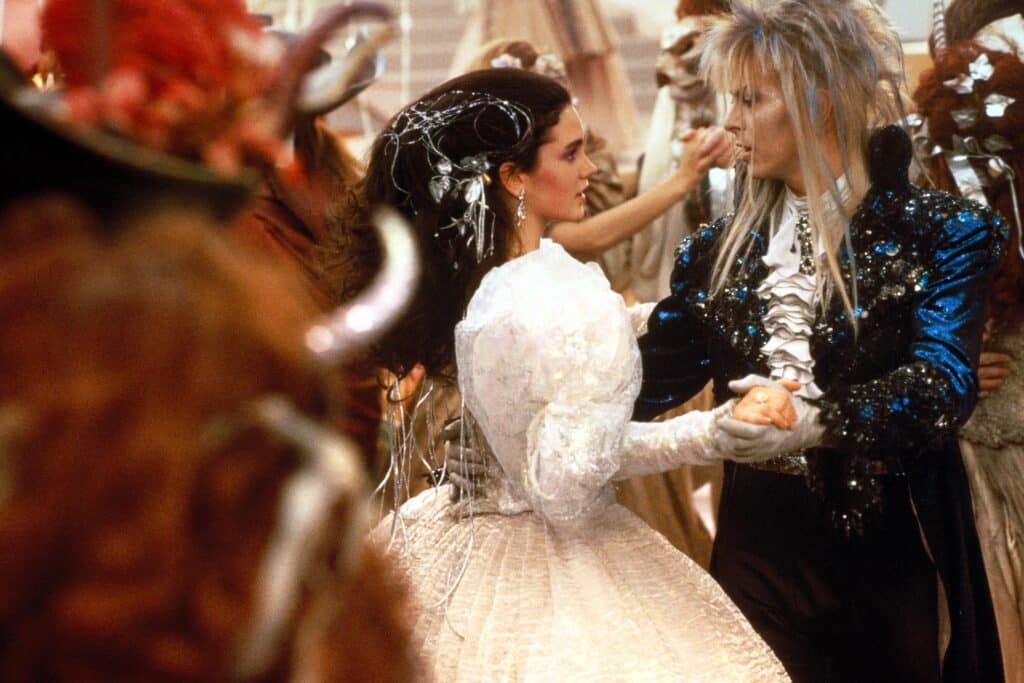
The masquerade ball is a circular time, a spell where everything could remain unchanged forever. “It’s only forever, not long at all,” the song sings. But Sarah breaks the illusion. She chooses reality, her will, her crown. She does not conquer with swords; she triumphs with awareness and sovereignty. Every crystal Jareth used to manipulate shatters, revealing our limiting beliefs. Once we stop giving them power, they become mirages.
The masquerade ball is one of the film’s most revealing moments. Pure theater. A space where no one shows their true face, and desire dresses as elegance. Sarah participates without being fully present, as if watching herself from outside. Fairy-tale fantasy at its most perfect and empty: all shines, yet nothing is consciously chosen.
The leap over the Escher stairs is symbolic: leaving the mind behind, trusting the heart, and crossing life’s labyrinth.
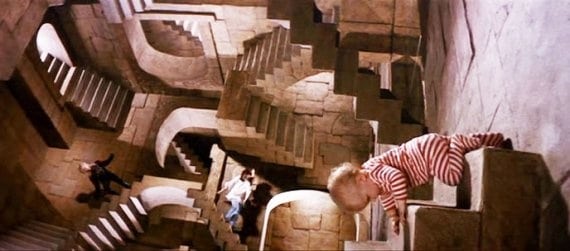
Sarah navigates the labyrinth with more than courage: with imagination. Her bond with books, words, and stories is no minor detail. The challenge is not abandoning fantasy, but learning to wield it without being trapped. The labyrinth returns this power transformed: not as escape, but as conscious creative force.
Closing the Circle: From Rosario to the Present
I went to the cinema to close a chapter that began in Rosario. I am the one taking the reins of my story, recognizing my own power; the woman who calls to the stones, dances her own rhythms, and breaks bubbles. Outside, the world can be a dark labyrinth, but like Sarah, we have the map: magic lives in looking shadow in the eyes and reclaiming the crown.
The return does not mean forgetting. The magical world does not vanish; it integrates into the everyday, like cycles, dreams, and the body’s memory. The final dance is not a wedding or coronation, but a dance of reconciliation. In Sarah’s room, intimate and sacred, all figures from the journey reappear—not as escapist fantasy, but as allied forces. The labyrinth persists, because life is movement and trial, yet now Sarah recognizes her inner rhythm. She no longer walks lost: she dances. And in that dance, the world comes alive again.
Initiatory stories do not end when the lights go out. Their purpose is not to explain, but to accompany. True myth leaves tools: words, symbols, gestures we can use when the labyrinth reappears in daily life, under new names and faces.
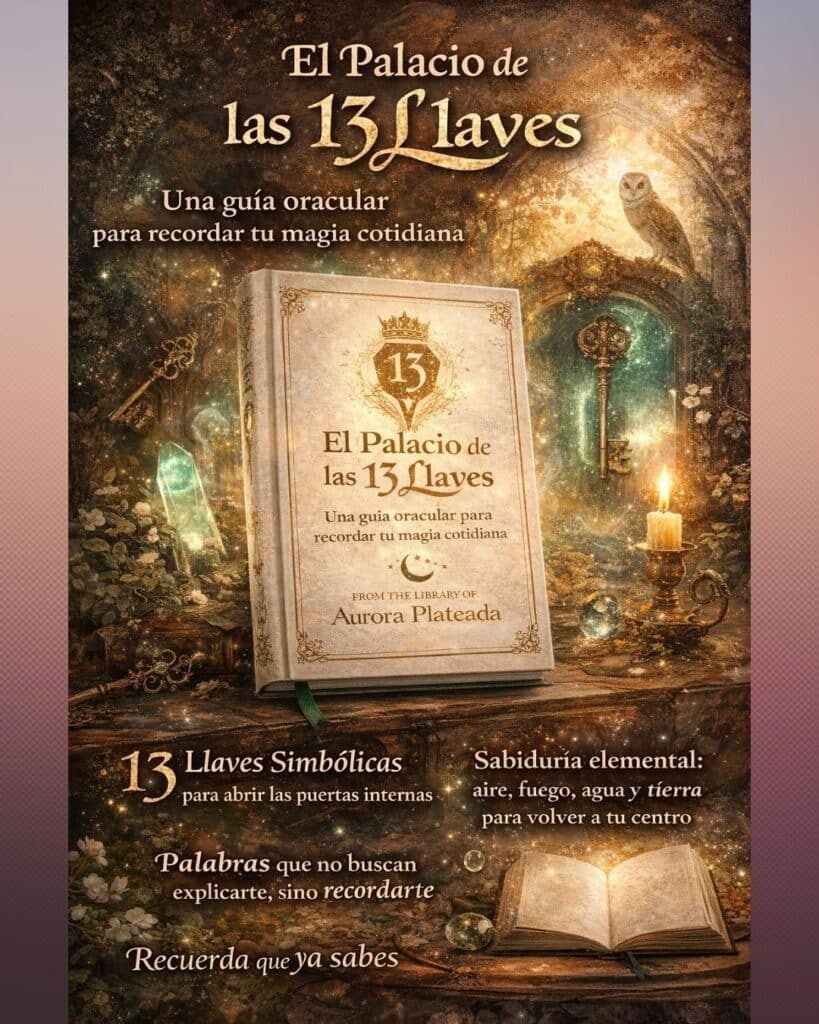
Oracular Guide: “The Palace of 13 Keys”
Like Sarah, we need tools to navigate our inner labyrinths:
- Galleries of the Elements: Gentle rituals to return to your center when feeling fragmented.
- Key of Sovereignty: Transform “You have no power over me” into an everyday shield.
- Guidance of Sir Giz: Guardian whispering that time and the map are on your side.
This guide can be downloaded through a conscious donation on Ko-fi and used as a personal oracle to open inner doors. It is also possible to schedule sessions to walk together through passages that feel darker today.
“If you prefer to read this reflection in Spanish, you can find the original version here: Labyrinth (1986): El mapa oculto del poder femenino




[…] choreography, and interwoven voices are like threads of one shared memory: the audience feels the musical with their entire […]